THE ASAM CRITERIA CONTINUUM™ IN CRIMINAL JUSTICE SYSTEMS: A WHITE PAPER
David R. Gastfriend, M.D., DFASAM | November 25, 2025
While among the general U.S. population, approximately 8% of people meet criteria for substance use disorders (SUD) (SAMHSA, 2019), SUDs are far more common among arrestees, i.e., approximately 41% (Prison Policy Initiative, 2024), with nearly 2 out of every 3 incarcerated persons in U.S. jails and prisons having an SUD (Bronson, et al., 2020).
The American Society of Addiction Medicine (ASAM), the nation’s leading medical society for SUD, states that all components of the criminal justice system should address substance use problems as treatable medical conditions and to effectively assess, treat, and effect the continuity of care for individuals with SUD – a particularly critical need in the midst of the current U.S. opioid epidemic (ASAM, 2020). This applies to all justice system phases, including deflection, diversion, incarceration, re-entry, parole and probation. Individuals with these problems need careful, systematic, and multi-dimensional evaluation, whether their condition is being considered in the process of arrest, defense, prosecution, adjudication, incarceration or beyond.
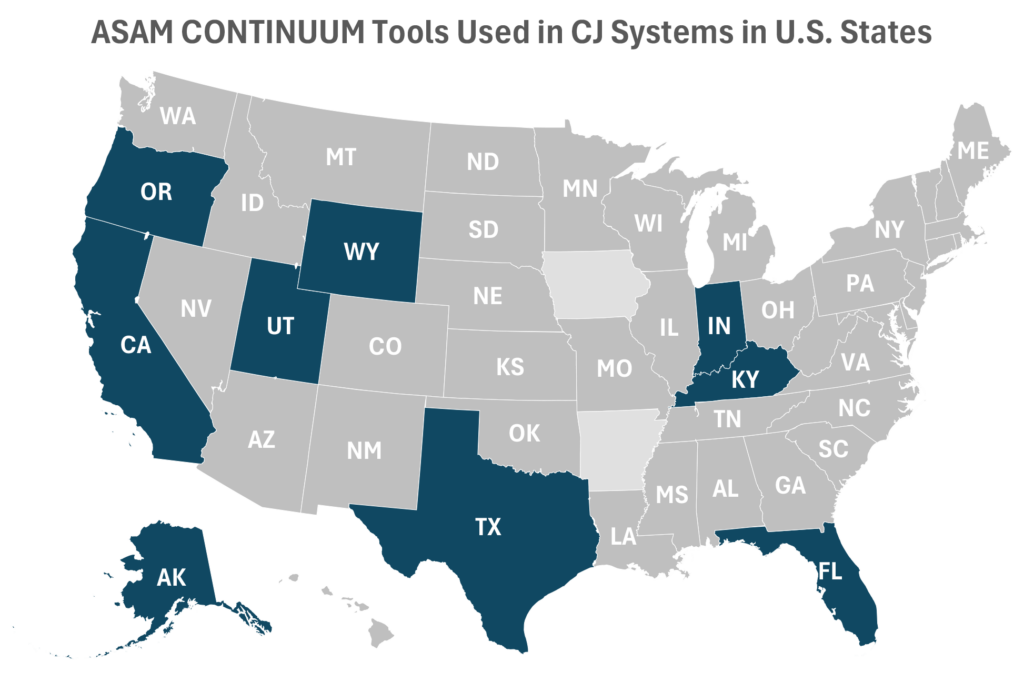
The CONTINUUM set of tools first entered use for assessment of patients involved in the criminal justice system in the U.S. in 2018. Within a few years, these tools entered use in 14 different criminal justice systems, spanning nine different U.S. states, plus Guam and Bermuda. In the U.S., their use includes large states with major metropolitan areas, such as California, Florida, and Texas, but also many rural regions, including Alaska, Oregon, and Utah.
In U.S. justice systems, the largest proportion of individuals are arrestees, with recent FBI data reporting over 7 million arrest events per year. Of these, Bureau of Justice Statistics data indicate that nearly 3.8 million are under community supervision, e.g., parole or probation, which represents roughly 66% of the total correctional population. The remaining one-third, or almost 2 million, are incarcerated in jails or prisons. Only about 2% of justice system-involved individuals are monitored in the nation’s 4,000 drug or DUI courts, approaching 150,000.
Entities from all of these systems currently utilize the CONTINUUM toolkit. These include major state departments of corrections (e.g., California, Alaska and Kentucky) and county departments of corrections and probation (e.g., Potter County TX, which includes Amarillo). In addition to use in prison systems, the tools are used in jails and county detention centers (e.g., Kenton County KY) and county sheriff’s offices (e.g., Tooele County UT). Courts are a site of use (e.g., 11th Judicial Circuit Court of FL) as well as county public defender associations (e.g., Utah County, the second most populous county in Utah, including Provo). The Judiciary of Guam uses CONTINUUM for its Client Services and Family Counseling Division and Bermuda’s Department of Court Services uses all three tools.
Of the 463 subscribers to date who focus on criminal justice-involved clients, 59.2% use the CO-Triage tool while 40.8% use the full CONTINUUM or RISE versions. Of the three tools, the CO-Triage receives the most frequent use, with the Correctional Health Care Services of California’s Department of Corrections and Rehabilitation representing a third of all CO-Triage subscriptions (37.6%). Other systems with significant numbers of interviewers using CO-Triage include Alaska’s Department of Corrections (50), Kentucky’s Department of Corrections (65), and Los Angeles County’s Correctional Health Services (40).
These tools have been used for patient assessments over 200,000 times, with 55.4% employing the CO-Triage assessments, 15.5% CONTINUUM, and 29.1% the RISE.
Impacts have been noted in the course of adopting these tools, according to the Integrated Substance Use Disorder Treatment (ISUDT) program of the California Department of Corrections and Rehabilitation (CDCR)(Allen, et al., 2025). The ISUDT program is a comprehensive approach to treating SUD across the state’s correctional institutions. This program included adoption of the ASAM CO-Triage and CONTINUUM in 34 state prisons to determine individuals’ SUD severity, needs, Level of Care and to assign medications, counseling and behavioral therapies in a “Whole Person” approach. Whereas the U.S. experienced a 600% increase in the number of people who died of drug or alcohol intoxication in state prisons in recent years (Carson, 2021), the ISUDT program has shown reductions in drug overdose mortality.
REFERENCES
Allen DM, Homans M, Hutchinson J, Lucas K, Lisa Heintz L, Kanan R, Kalauokalani D. Impacts of the Integrated Substance Use Disorder Treatment (ISUDT) Program on Morbidity and Mortality. ISUDT 4th Annual Outcomes Report | May 2025. California Department of Corrections and Rehabilitation & California Correctional Health Care Services. May 2025. pp. 25. https://cchcs.ca.gov/wp-content/uploads/sites/60/Impacts-of-the-Integrated-Substance-Use-Disorder-Treatment-Program-on-Morbidity-and-Mortality-M.pdf
American Society of Addiction Medicine. National Practice Guideline for the Treatment of Opioid Use Disorder: Part 12 – Special Populations: Individuals in the Criminal Justice System. J Addict Med. 2020;14(5S Suppl 1):S193-S232.
Bronson J, Stroop J, Zimmer S, Berzofsky M. Drug Use, Dependence, and Abuse Among State Prisoners and Jail Inmates, 2007-2009. US Bureau of Justice Statistics Special Report. 2020;(NCJ 250546):26.
Carson EA, Mortality in State and Federal Prisons, 2001-2018 – Statistical Tables. U.S. Department of Justice Office of Justice Programs, Bureau of Justice Statistics · Statistical Tables, April 2021, NCJ 255970
Prison Policy Initiative. Addicted to punishment: Jails and prisons punish drug use far more than they treat it. Briefings. January 30, 2024. Accessed October 10, 2025. https://www.prisonpolicy.org/blog/2024/01/30/punishing-drug-use/
Substance Abuse and Mental Health Services Administration (SAMHSA)’s Data Analysis System (DAS). Survey: NSDUH: Public-use Data (2019), https://datatools.samhsa.gov/das/nsduh/2019/nsduh-2019 ds0001/crosstab?row=UDPYILAL&weight=ANALWT_C. Run at: 10 Oct 2025, 5:26 PM